Save the Children’s CUBIC Behavioral Science Toolkit
INTERNATIONAL DEVELOPMENTYOUTHSOCIAL BEHAVIOUR CHANGE
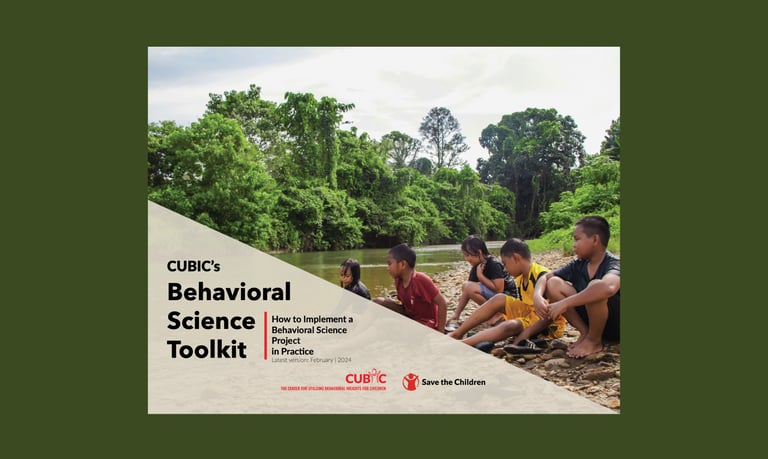

This toolkit helps development and humanitarian practitioners apply behavioural insights to programmes for children and families. Enabling them to design interventions that more effectively drive real behaviour change in areas like health, education, and protection. It offers a structured approach to embedding behavioural science throughout the project cycle, helping teams increase programme uptake and maximise impact within communities.
Created by:
CUBIC: the Center for Utilising Behavioral Insights for Children at Save the Children International (2024)
What’s inside:
A practical, step-by-step guide built around the Behavioural Insights Unit’s TESTS framework: Target, Explore, Solution, Trial, Scale.
Each phase shows how to apply behavioural insights in practice:
Target: Define the specific behaviour to change and whose behaviour it is.
Explore: Research to diagnose the underlying barriers.
Solution: Co-create ideas informed by behavioural science, then move through Trial (piloting) and Scale (expanding what works).
The toolkit includes tools and templates for every stage, from bias-mapping worksheets to field-trial planning guides, plus real-world examples from Save the Children projects. It also provides guidance on key behavioural principles (like status quo bias and social proof) and how they appear in child-focused programmes. It adapts the standard behavioural project process to the realities of children’s welfare and rights.
Related Behavioural Design Toolkits
Behavioural Design Toolkits ©2026
A curated library of behavioural science and design toolkits to help you understand and shape human decisions.
Get the latest in your inbox
Subscribe to our newsletter